

Editor's note: This month only – grab $5 off five classic ebooks in the November deal. Click the link for details. Thanks for reading, Andrew.
In last week’s article I touched on the idea of visual context. I’d like to expand it on it today, because it’s something I’ve become more aware of in my own photography. I’ve been including more visual context in my flower and garden photos, and they’ve improved as a result.
Like last week’s article, these ideas apply no matter what type of photography you do (there are some examples with portraits and documentary photos at the end).
Why is visual context important?
A photo of a flower with a completely blurred background could have been made anywhere. Providing visual context is the opposite of that. It roots your photo in a specific place.
The idea is to make flower photos that could only have been made in one garden or landscape, at a specific point of time. The clue is in the setting – the visual context. It’s about stopping the aperture down and revealing the background. Showing other plants and flowers. Revealing architectural features like walls, paths and buildings. They don’t have to be sharp. But there has to be enough detail for them to be recognizable.
The same idea also applies to portrait, documentary and travel photography – to any subject where you might be tempted to move in close, exclude as much of the environment as possible, and use a large aperture to blur the background.
Different levels of visual context
There are three levels of visual context in flower and garden photography. I’ll explore this idea using photos that I made a week ago in The Garden House – a beautiful garden in west Devon.
1. Flowers with foliage detail
In this type of photo, you see a single flower with foliage in the background. But rather than completely blurring the foliage, it’s sharp enough to reveal texture and detail.

You make this type of photo by pulling back. These aren’t close-up photos – I made them with my 56mm lens (on an APS-C camera) without an extension tube or close-up lens.
If you have a prime lens, it’s tempting to set it to the widest aperture because of the beautiful bokeh. But if you want visual context, you need to stop down. Maybe not much – I made both photos above with an aperture of f2, one stop down from the lens’s largest aperture of f1.2. The point is you need to experiment, and get to know the lens you’re using.
If you have a maximum aperture of f1.2, like my 56mm lens does, then make photos at f1.2, f2, f2.8 and f4. You can look at them on your computer afterwards and make up your mind which works best. But it’s important to make the photos in the field, because the moment isn’t coming back. Next time you visit the garden, it will be different.
I call this process aperture bracketing. After you’ve done this two or three times you’ll figure out the optimum aperture settings for your lens, and you won’t need to bracket so much. Going through this process has taught me to use f2 on my 56mm lens, and f2.8 on my 35mm and Helios 58mm lenses.
2. Flowers with other flowers and plants
The next level is to photograph flowers with other flowers and plants in the background and foreground. One of my favorite techniques is to shot through other flowers, using selective focus to throw them out of focus.
To make this work look for flowers growing closely together, especially flowers with different colors and shapes. This is a very pure style of photography that anybody can enjoy. It’s not just about the flower – it’s about color, shape, texture and placement. It’s nearly abstract, an exercise in composition. The flower is the subject, but it lets you explore all these other things.
Here are some examples. In the first I was photographing a dahlia when I noticed the large, dark leaves of a tropical plant next to it. So I reframed the photo to include them in the background, juxtaposing it with the dahlia.

In the next, I shot through the silvery leaves, using them to frame the red dahlia. I also included a stake in the composition, rather than trying to hide it. Again, it’s about context – plant supports like stakes are part of the garden.

The next example shows the result of stepping back to include even more of the background. The flowers in the background create splashes of color that offset the sharp purple flower near the top of the frame.

3. Flowers with architectural features
Gardens have a mixture of hard and soft landscaping. Hard landscaping is man-made. It includes walls, fences, paths and buildings. It makes gardens unique – no two gardens have the same hard landscaping features.
Soft landscaping is the flowers and plants. These are also unique to the garden. But you have to work harder to capture that uniqueness, by adding visual clues that tell you where the photo was made.
That’s where this level of visual context comes in. The idea is to include the garden’s architectural features in the background of your flower photos. They don’t have to be in sharp focus (although they can if you want). They just have to be there – providing the visual context that roots your flower photos in space and time.
The photos below show how it works. The walled garden in the Garden House is surrounded by a stone wall and two historical buildings built from gray stone. I included them in the background of these flower photos. I used a wide aperture to blur the buildings. I hinted at them, rather than reveal every detail. But that’s all that’s needed for the images to work.


Visual context and other types of photography
These ideas apply to any type of photo where you can move in close to the subject and blur the background with a large aperture. There’s nothing wrong with that technique and you can make beautiful photos with it. But what if you set yourself a brief to make photos that show visual context instead?
Visual context in portrait photography
When you make portraits you can close in on the model’s face and use a large aperture to blur the background. It’s what you do when the model is more important than the background. It’s also what you might do in a studio, with a plain backdrop.
But if you’re in an interesting location then it’s different. You can think about pulling back and showing more of the background. Like the flower photos, it’s about rooting the portraits in the place you made them. It’s the reason I like to make portraits outdoors.
The two portraits below show both techniques. I made them in the same place and with the same lens (85mm, full-frame). But for the second portrait I stood further back to include more of the model and the background in the composition.

Visual context in documentary photography
The same applies to documentary photography. The hands in the photos below belong to potter Tony Sly, based in Raglan, New Zealand. I made both photos with the same 56mm lens I’ve been using for my flower photos. For the first I closed in, simplifying the composition. But for the second I stepped back, including more of the background to create visual context. The second photo shows more of the environment. It could only have been made in one place.

Conclusion
This is one of the more complex ideas I’ve explored about composition and I hope it’s useful to you. I started thinking about visual context early this year, and it made its way into my book 52 Flower, Garden & Nature Photography Assignments as Assignment #31: In context (see page 82 if you have the book). It’s since become central to my thinking and changed the way I make flower and garden photos. It’s a powerful idea, so experiment with it to see how it affects the photos you like to make.
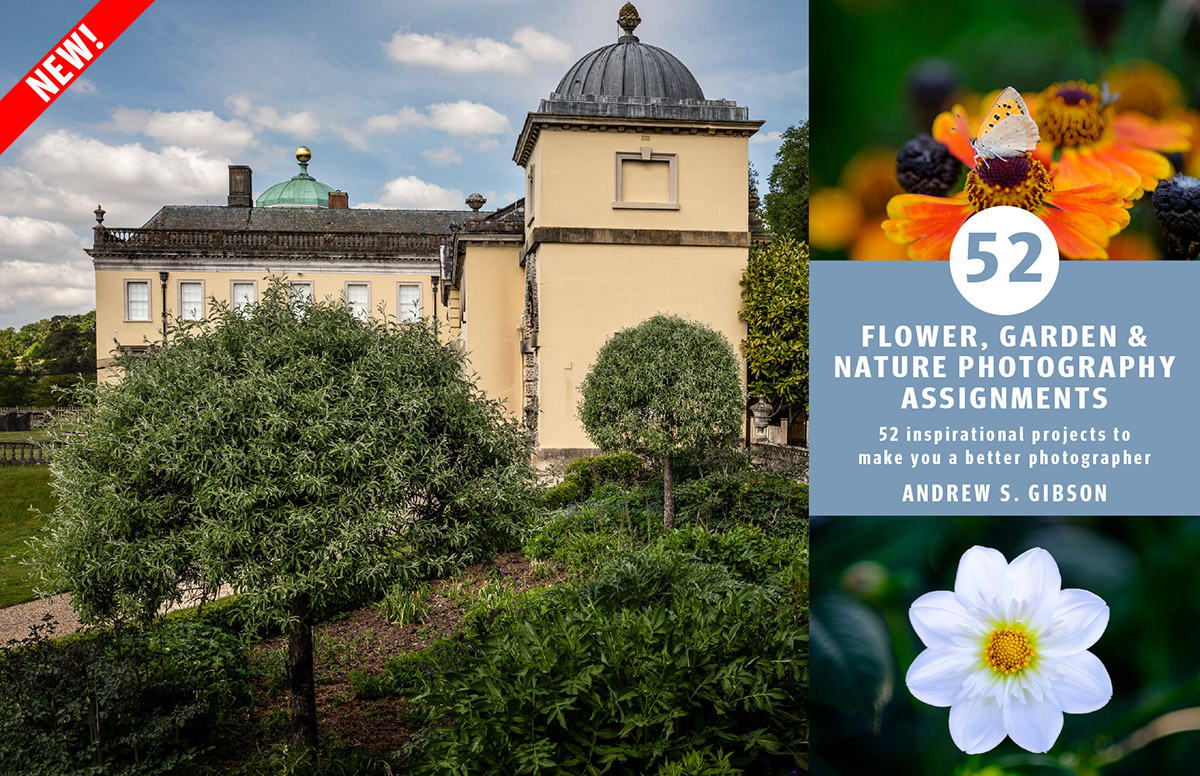
Further reading: 52 Flower, Garden & Nature Photography Assignments
Visual context is just one idea from my book 52 Flower, Garden & Nature Photography Assignments. It has enough ideas and inspiration to keep you busy for a long time to come. It’s worth checking out, and you can buy it today for just $15. Click here for the details.
Just curious? Click here to download a free 20 page sample.

