

Editor's note: This month only – grab $5 off five classic ebooks in the November deal. Click the link for details. Thanks for reading, Andrew.
When I started flower photography I embraced simplicity. I went for bold, graphic compositions with strong use of color.
This year, my approach has evolved. Instead of moving forward to get closer to flowers, I step back to fit more in the frame. I look for things to add to my compositions, not things to take away. In other words, I’m experimenting with visual complexity. You’ll love these ideas if you’re into flower photography. But there’s something useful here for everybody, no matter what type of photography you do.
Simplicity in photographic composition
Simplifying your photos is a great way to make stronger, bolder images. It teaches you how to use texture, shape, form and color for impact.
In flower photography, the easiest way to simplify your compositions is to photograph a single flower against a background of dark green foliage. These photos show how it works.

Visual complexity in photographic composition
There’s nothing wrong with this approach, and I return to it regularly. But this year something changed. I’ve started using my 56mm lens more (on an APS-C camera). I like the way it crops the scene and compresses layers.
The interesting thing is that because it can’t focus on subjects close to the camera, it’s given me a different mindset. I don’t think of it as a close-up lens. If I want to get in close, I use my 100mm macro, or my Helios 58mm or Fujinon 35mm lenses with close-up lenses attached. But with this lens, I keep further back.
Another change is that I see the gardens I visit differently as I learn more about horticulture and garden design. I’m aware of the planting choices, and which flowers go together. Now, instead of photographing a single flower against a blurred background, I show the surrounding plants and flowers. I’m looking for visible detail, interesting juxtapositions and context, rather than isolation.
A photo of a flower with a blurred background (like the ones above) could have been made anywhere. Including more visible detail is a different approach. It roots the photo in a particular place. It could only have been made in a specific garden.
Here are some photos I made earlier in the year that start to show these ideas in action. The compositions are more complex and you can see the elements I’ve been talking about.


Learn more: The Composition Secrets of Great Flower Photography
A recent visit to RHS Rosemoor
Last month I visited the gardens at RHS Rosemoor in north Devon. If you live close enough, or you’re passing through, then I recommend you pay a visit and take your camera. There are thousands of beautiful flowers on display from late March to mid-November.
At this point I was more interested in creating complex compositions. I set myself the assignment of using my 56mm lens to make complex compositions (check out my book 52 Flower, Garden & Nature Photography Assignments for more assignment ideas).
Inside the cool garden
RHS Rosemoor covers 65 acres, divided into smaller gardens. The cool garden has a muted color scheme. The color palette is blue, white and purple. Water runs through rills. The aesthetic is cool and calming. These are all elements I wanted to capture in my photos.
There’s lots of Russian sage in the cool garden, a plant whose beauty and scent I’ve only just started to appreciate. I included it in as many frames as I could.
I set a wide aperture and shot through other planting to create an out of focus layer in the foreground, adding a sense of depth.


The long border
Then I moved onto the long border, 150 meters of hedging and planting. There’s Russian sage here too, and dahlias, and Verbena bonariensis. I like them all, and worked them into my compositions, showing the dahlias and Russian sage together, with the formal hedging in the background.


The hot garden
The planting changes again in the hot garden. Plants are red, yellow, purple and orange. It’s a fiery color palette, and the garden looked beautiful, packed full of dahlias in full flower. Again, I went for detail and juxtaposition, photographing the dahlias and Verbena bonariensis together, filling the frame with vivid red and purple hues.


The cottage garden
Then I moved onto the cottage garden, with its scented and colorful flowers. The planting is more varied, with roses, dahlias and sweet peas, among others. There were fewer planting juxtapositions to be had here, but I still liked the complex backgrounds, with the soft muted tones of green.


Visual complexity and wide-angle lenses
A normal or telephoto lens is ideal for creating these layered, textured compositions. But you can make complex photos with wide-angle lenses. They fit lots into the frame, and are ideal for making scene setting compositions that show detail and context.
To make complex images like these work, you need to include a strong focal point like the buildings in the photos below, made earlier this year at East Lambrook Manor gardens. This is no longer flower photography, but garden photography. Flowers and plants play important roles in the photos, but they are no longer the main subject.


Learn more: Why Every Photographer Should Try Garden and Flower Photography
Visual complexity and structure
The best tip I can give you for working with complex compositions is that your photos must have structure. They need to be intentional and designed, even if they don’t come across that way.
You need to think about what goes into the frame, and what you crop out of it or hide through framing and aperture choice. I like to use a large aperture to blur parts of the scene. It simplifies the composition, avoiding making it too complex.
A clear idea helps. At RHS Rosemoor I shot with two ideas in mind – show the context, and juxtapose interesting planting combinations. These simple assignment briefs kept me focused on my goals.
It’s autumn as I write this, but if you’re into flower photography there’s still time to go out and put these ideas into action, in my part of the world at least. The gardens around here are full of dahlias and other beautiful flowers, and will be for a few more weeks. Pick a still day and get out there and do it. The opportunity won’t come around again until Spring.
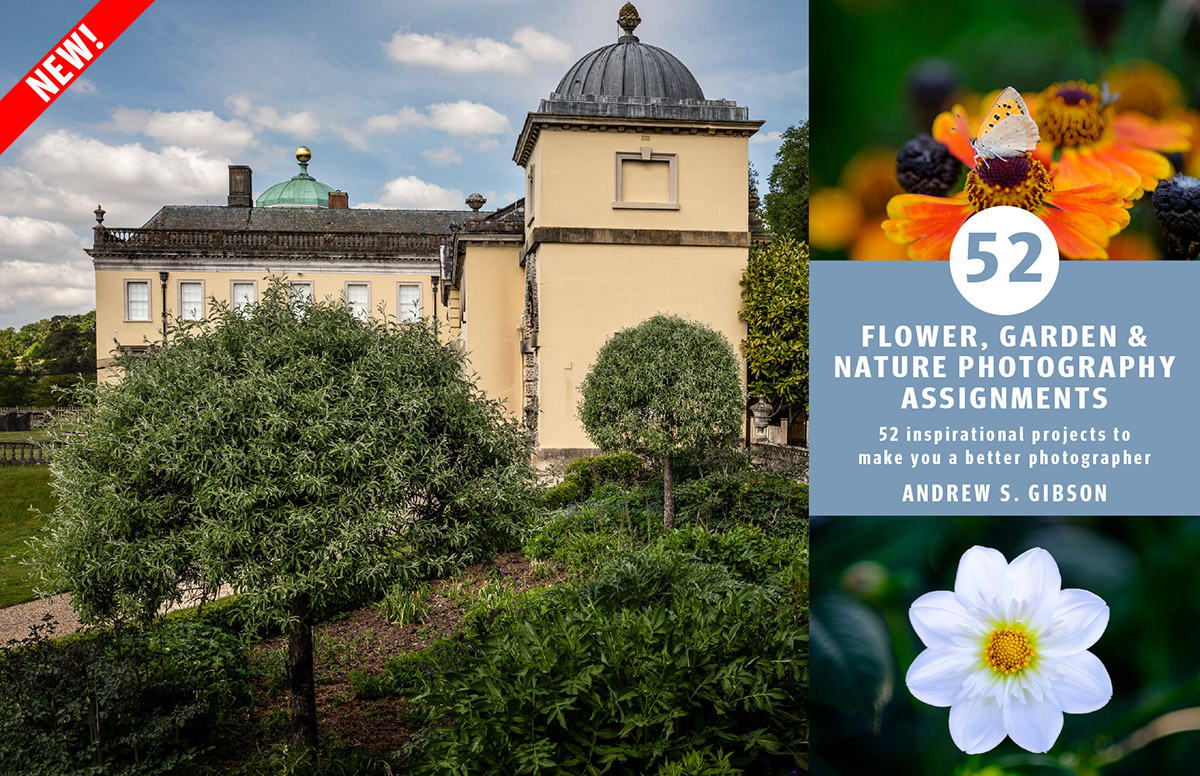
Further reading: 52 Flower, Garden & Nature Photography Assignments
Hopefully these flower photos show you how assignments are a great way to improve your photography. The important thing is to set yourself constraints – a brief that helps you get the most from your visit. It gives you focus, purpose and liberates your creativity.
That’s why I wrote my new book 52 Flower, Garden & Nature Photography Assignments. It has enough ideas and inspiration to keep you busy for a long time to come. Buy it today for just $15. Click here for the details.
Just curious? Click here to download a free 20 page sample.
